
130610 | Rare Cornish black honeybee found to resist colony collapse virus
Submitted by Angarrack.info ... on Mon, 30/09/2019 - 23:00.
Rare Cornish black honeybee found to resist colony collapse virus
10 Jun 2013
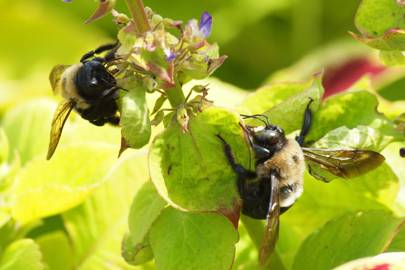
Jim Bauer/Flickr/CC BY-ND 2.0
The Cornish black honeybee, once believed to be extinct but still extremely rare, could be key to saving worldwide bee populations from colony collapse disorder.
According to the BBC, research from Paignton Zoo has shown the black bee is better at fighting off varroa mites. They carry the deformed wing virus, which has been implicated in the deaths of bees around the world.
Colony collapse disorder is a term that applies to a range of unknown factors that has led to the widespread decline of honeybee populations around the world.
It is likely to be a mix of many different issues coming together to kill millions of bees every year, threatening the human food supply chain. Colony collapse disorder is thought to be exacerbated by the limited range of bees that are bred by beekeepers.
Black honeybees like the Cornish variety were thought to have been driven to extinction by a virus more than 100 years ago, with beekeepers having since relied upon southern European varieties.
However, new populations were discovered on the fringes of the British Isles in 2012 by the Bee Improvement and Bee Breeders' Association, which has run a conservation program dedicated to the black bees since 1997. Fewer than one percent of British bees are native black bees, however.
With larger bodies and thicker hair, the black bees are believed to be better able to survive longer and colder winters -- something that has become more of an issue with climate change causing irregularities in the British climate. A third of US honeybees were killed last winter, too, so winter hardiness is of major importance.
It now seems that those larger hairs are also good at preventing the mites clinging onto each bee, making it harder for them to get infected with the deformed wing virus.
The zoo hopes to encourage beekeepers to take on the breed, with the advantage that, at the very least, an increase in biodiversity will hopefully make one single colony collapse factor less devastating if it does strike.
Image: Jim Bauer/ Flickr/CC BY-ND 2.0
- Printer-friendly version
- Login or register to post comments
- Permalink
Contributions
- Angarrack Defibrillator Team (26)
- Angarrack Inn (336)
- Angarrack Methodist Chapel (3)
- AngarrackSanta (2)
- Carol (15)
- Gail (1)
- GordonG (12)
- Hayle Development Group on Facebook (5)
- Hayle Harbour Authority (4)
- Hayle Town Council (5)
- louise (1)
- Lynne (111)
- Mal (1)
- MattBuckley66 (9)
- Neil (22)
- Neils Garden Care (9)
- Russell (21)
- Secretary - Christmas Lights (148)
- Steve (3)
- webmaster (5129)


Recent comments
38 weeks 6 days ago
43 weeks 6 days ago
43 weeks 6 days ago
1 year 6 weeks ago
1 year 26 weeks ago
1 year 26 weeks ago
1 year 26 weeks ago
1 year 26 weeks ago
1 year 48 weeks ago
2 years 10 weeks ago